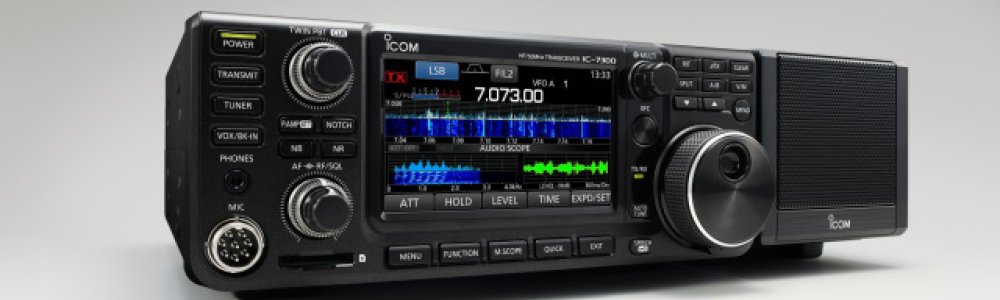
My journey into HF started with the Icom IC‐7300, and it’s still my main transceiver. When I bought it in 2020 it was one of the best‐selling HF radios on the market, and it’s easy to see why. It samples the RF signal directly and does the rest in an FPGA, which keeps the circuitry simple and the receiver quiet.
Key features
- Bands: HF and 6m, 100 W; receives 0.030 to 74.800 MHz
- Modes: SSB, CW, RTTY, AM and FM, plus digital modes via the built‐in USB audio
- Real‐time spectrum scope on a 4.3‑inch colour touchscreen
- Built‐in automatic antenna tuner for an SWR up to 3:1
- SD card slot for firmware updates, recordings and settings
- 101 memory channels and a built‐in CW keyer
The spectrum scope is the feature I’d miss most. Seeing the whole band at a glance makes finding activity, and spotting interference, much easier than tuning around blind.
The 4m modification
My IC‐7300 was modified by the supplier to transmit on the 4m (70 MHz) band, which has been available to full licensed radio amateurs in the Netherlands since 2012. Not many HF radios cover 4m out of the box, so it’s a nice extra. I haven’t actually used the band yet, though: I don’t have an antenna for 4m so far.
How I use it
Most of my operating is in digital modes, mainly FT8, together with the Linux setup that keeps the radio’s clock in sync. The built‐in USB audio and CAT control mean a single cable to the computer is all it takes. My SSB experience so far comes mostly from the PACC contest weekends with the PA6D crew.
For bands my 10/20/40m end‐fed isn’t made for, the internal tuner isn’t enough, so I use an external one, currently an LDG AT‐1000ProII.
Limitations
- No 2m or 70cm; for VHF/UHF I use other radios
- The internal tuner can’t cope with high SWR
- No dual receive
- No panadapter output for an external display
None of these have really held me back. For a first HF radio, and still my main one, the IC‐7300 has been an excellent choice.