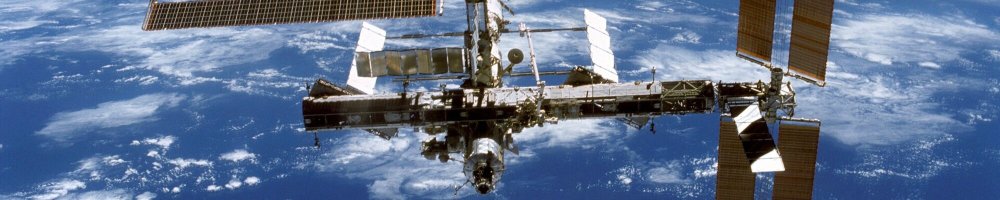
Satellites and the ISS
Contacts via space with a modest station
Making contacts via space doesn’t require a big station. A handheld with a small directional antenna can be enough for the ISS, and QO‐100 can be worked from Europe with a modest dish that never needs to move. My own first step was an APRS beacon received by the ISS.
Table of Contents
The International Space Station
The ISS carries amateur radio equipment, operated by the ARISS programme. Which mode is active changes regularly, so check the ARISS status page before a pass.
| Mode | Uplink (MHz) | Downlink (MHz) |
|---|---|---|
| APRS digipeater | 145.825 | 145.825 |
| FM voice repeater | 145.990 (CTCSS 67 Hz) | 437.800 |
| Crew contacts, Region 1 | 145.200 | 145.800 |
| SSTV events | 145.800 | |
The ISS uses the call signs NA1SS (the US and European modules) and RS0ISS (the Russian module), among others.
At the time of writing, ARISS reports that the APRS digipeater of the Russian station is being tested on 437.825 MHz.
Some tips:
- A pass lasts about ten minutes at most, and the ISS is only usable when it’s above your horizon. Apps and websites such as Heavens‐Above or the AMSAT pass predictions show when.
- Because of the speed of the station, the Doppler shift on 70cm is up to about ±10 kHz. On 2m it’s about a third of that.
- Never transmit on the downlink frequency, and keep repeater contacts short: call sign and locator is plenty.
- The SSTV events (mostly PD120) are announced in advance. Even a scanner with a vertical antenna can receive them; see also frequencies for SSTV.
QO‐100
QO‐100 is the first amateur transponder on a geostationary satellite, Es’hail‑2, launched in 2018. Seen from the Netherlands it hangs at a fixed position in the south‐southeast, which means a fixed dish is enough. It covers Europe, Africa, the Middle East and large parts of Asia.
Narrowband transponder (SSB, CW and digital modes up to 2.7 kHz):
| Uplink (MHz) | Downlink (MHz) | |
|---|---|---|
| Transponder | 2400.000‑2400.500 | 10489.500–10490.000 |
| Lower beacon (CW) | 10489.500 | |
| Middle beacon (PSK) | 10489.750 | |
| Upper beacon (CW) | 10490.000 | |
Within the narrowband transponder, the lower part is for CW, followed by digital modes, then SSB; the top part is for mixed modes and contests. See the AMSAT‐DL band plan for the details.
Wideband transponder (digital amateur television): uplink 2401.0–2410.0 MHz, downlink 10490.5–10499.5 MHz, with a DVB‐S2 beacon on 10491.5 MHz.
The most important operating rules:
- Keep your signal below the level of the beacons.
- No FM or other modes wider than 2.7 kHz on the narrowband transponder.
- Full duplex is mandatory: listen to your own downlink while you transmit.
The downlink can be received with a satellite TV dish and an LNB, preferably one with a stable reference oscillator. With the standard local oscillator of 9750 MHz, the narrowband transponder appears at 739.500–740.000 MHz, within reach of most SDR receivers. For the uplink on 13cm you need a few watts and a dish of 60 to 90 cm. Check which bands your licence class allows.
Pointing at QO‐100 from the Netherlands
QO‐100 is at about 26° East. From the Netherlands the dish points south‐southeast, at an elevation of about 26 to 29 degrees. The azimuth is relative to true north; a compass shows magnetic north, which in the Netherlands differs by only a few degrees.
| Location | Azimuth | Elevation |
|---|---|---|
| Groningen | 156° | 26.6° |
| Leeuwarden | 155° | 26.4° |
| Zwolle | 155° | 27.2° |
| Amsterdam | 154° | 27.0° |
| The Hague | 153° | 27.1° |
| Utrecht | 154° | 27.3° |
| Enschede | 156° | 27.7° |
| Rotterdam | 153° | 27.3° |
| Middelburg | 152° | 27.4° |
| Eindhoven | 154° | 28.0° |
| Maastricht | 155° | 28.7° |
Other satellites
Besides the ISS and QO‐100 there are several satellites in low earth orbit, with FM repeaters or linear transponders for SSB and CW. Their status changes over time, so the AMSAT status page is the best place to see which are currently active.