SWR and return loss
What an SWR reading really means
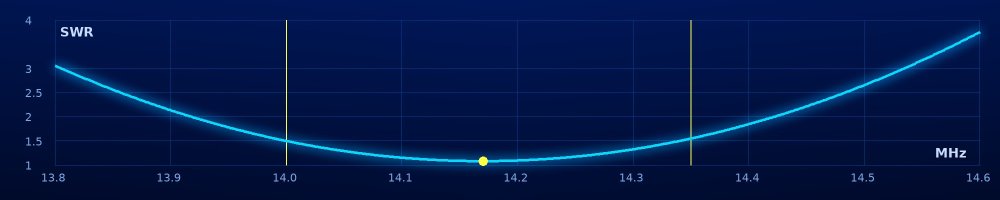
An SWR meter or antenna analyser tells you how well your antenna matches the 50 Ω of your transceiver and coax. Different instruments show this in different ways: SWR, return loss or reflection coefficient. This page converts between them and shows how much power is actually lost.
Table of Contents
Conversion table
| SWR | Reflection coefficient | Return loss (dB) | Reflected power | Mismatch loss (dB) | Resistive load (Ω) |
|---|---|---|---|---|---|
| 1.0:1 | 0.000 | ∞ | 0.0% | 0.00 | 50 |
| 1.1:1 | 0.048 | 26.4 | 0.2% | 0.01 | 55 or 45.5 |
| 1.2:1 | 0.091 | 20.8 | 0.8% | 0.04 | 60 or 41.7 |
| 1.3:1 | 0.130 | 17.7 | 1.7% | 0.07 | 65 or 38.5 |
| 1.5:1 | 0.200 | 14.0 | 4.0% | 0.18 | 75 or 33.3 |
| 1.7:1 | 0.259 | 11.7 | 6.7% | 0.30 | 85 or 29.4 |
| 2.0:1 | 0.333 | 9.5 | 11.1% | 0.51 | 100 or 25 |
| 2.5:1 | 0.429 | 7.4 | 18.4% | 0.88 | 125 or 20 |
| 3.0:1 | 0.500 | 6.0 | 25.0% | 1.25 | 150 or 16.7 |
| 4.0:1 | 0.600 | 4.4 | 36.0% | 1.94 | 200 or 12.5 |
| 5.0:1 | 0.667 | 3.5 | 44.4% | 2.55 | 250 or 10 |
| 10.0:1 | 0.818 | 1.7 | 66.9% | 4.81 | 500 or 5 |
The last column shows which purely resistive load gives this SWR in a 50 Ω system: either 50 × SWR or 50 / SWR. A 200 Ω load, for example, gives the same SWR of 4:1 as a 12.5 Ω load. Real antennas usually also have a reactive part, so the same SWR can come from many different impedances.
What the numbers mean
An SWR of 1.5:1 looks less than perfect, but only 4% of the power is reflected, and the loss is less than 0.2 dB. Nobody on the other side will notice the difference. Even at 2:1 the mismatch loss is only half a dB.
The real issues with a high SWR are elsewhere:
- The transceiver reduces its output power to protect itself, often from about 2:1 upwards.
- Extra cable loss: reflected power travels up and down the coax, losing some of it each time. With a long or lossy cable (see coax cable loss) this adds up.
- An ATU in the shack makes the transceiver happy, but doesn’t change the SWR on the cable to the antenna.
A low SWR also doesn’t guarantee a good antenna: a dummy load has a perfect SWR and radiates nothing. And because cable loss makes reflected power look smaller, a long lossy cable will flatter the SWR measured in the shack.
Formulae
With $\Gamma$ the magnitude of the reflection coefficient:
Return loss and mismatch loss in dB:
The reflected power as a fraction of the forward power is $\Gamma^2$.