Signal reports
RST, S-meter and SNR explained
Almost every QSO starts with a signal report. It tells the other station how well you receive them, and it is part of the minimum information needed for a valid contact. Depending on the mode, the report takes a different form.
Table of Contents
The RST system
The classic report has three parts: readability, strength and tone.
| Scale | Meaning | |
|---|---|---|
| Readability | 1–5 | 1 unreadable, 3 readable with considerable difficulty, 5 perfectly readable |
| Strength | 1–9 | 1 faint signals, barely perceptible, 9 extremely strong signals |
| Tone | 1–9 | CW only: 1 very rough, 9 a perfectly clean tone |
On phone you give two digits, so “59” means perfectly readable and very strong. On CW the tone is added: “599”. In contests nearly everyone gives 59 or 599 (sent as 5NN on CW), whatever the real signal, so a contest report says little about actual conditions.
The S‑meter
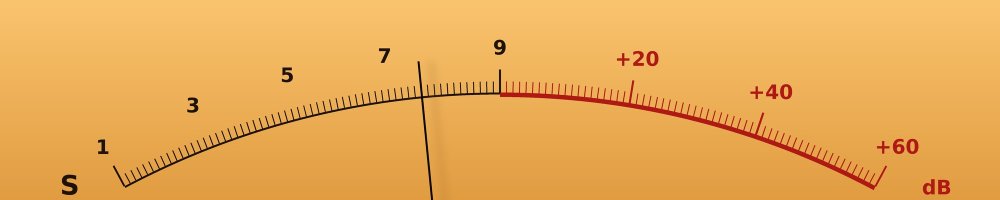
The strength figure usually comes from the S‑meter. IARU Region 1 recommends that S9 equals −73 dBm at the antenna input (50 µV across 50 Ω) below 30 MHz, and −93 dBm above 30 MHz, with 6 dB per S‑unit. In practice few S‑meters are calibrated this accurately, especially at the lower end of the scale, so treat the reading as an indication.
| S‑unit | HF (dBm) | HF (µV) | VHF/UHF (dBm) | VHF/UHF (µV) |
|---|---|---|---|---|
| S9+20 | −53 | 501 | −73 | 50.1 |
| S9 | −73 | 50.1 | −93 | 5.01 |
| S8 | −79 | 25.1 | −99 | 2.51 |
| S7 | −85 | 12.6 | −105 | 1.26 |
| S6 | −91 | 6.3 | −111 | 0.63 |
| S5 | −97 | 3.16 | −117 | 0.32 |
| S4 | −103 | 1.58 | −123 | 0.16 |
| S3 | −109 | 0.79 | −129 | 0.079 |
| S2 | −115 | 0.40 | −135 | 0.040 |
| S1 | −121 | 0.20 | −141 | 0.020 |
The voltages are across 50 Ω. For other values, or to convert into watts, see RF signal level conversions.
Digital modes
FT8, FT4 and the other WSJT‑X modes report the signal‐to‐noise ratio in dB, measured in a 2500 Hz bandwidth. That’s why reports are often negative: a signal of −15 dB is well below the noise you hear in an SSB filter, yet decodes without trouble. FT8 decodes down to about −21 dB, FT4 to about −17 dB.
In an FT8 exchange the report also tells you where you are in the QSO. A plain report such as “−12” is the first report; “R−08” means “roger, I received your report, and yours is −08”.
PSK31 and some other keyboard modes use RSQ, where the Q stands for the quality of the signal instead of the tone of a CW note.