About me
The journey to becoming a radio amateur
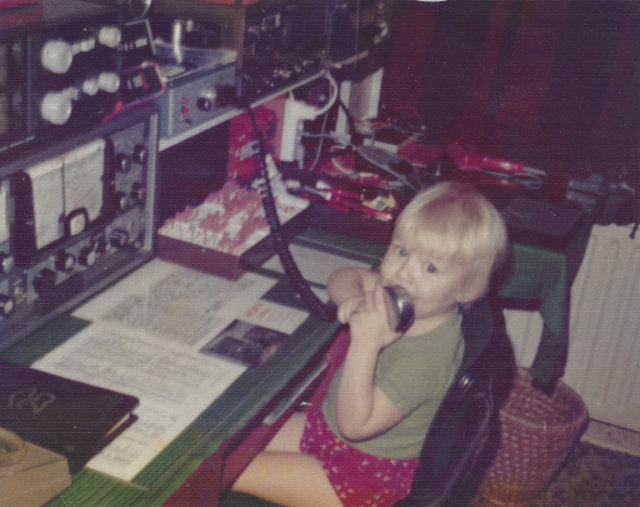
My first encounter with radio happened when I was around two years old. While most toddlers were playing with toys, I was drawn to the sounds coming from the equipment in our home. My father, PA0YQY, was a keen radio enthusiast, and I spent plenty of time exploring his shack, fascinated by the microphones and controls. I like to joke that I made my very first QSO back then, long before I actually understood what the term meant.
As I grew older, my curiosity shifted toward how things worked. Around my tenth birthday, my father gave me a Philips EE series experiment kit along with an extension set. I spent countless hours building circuits and following the manuals. I still keep those original kits and diagrams stored away in the shack today. Perhaps one day, my sons will pick them up and find them just as engaging as I did.
During my teens, I discovered 27 MHz CB radio. It was a practical way to chat with people across the neighbourhood and nearby towns. My father and I both took to it, experimenting with various rigs over the years—most notably a Midland 7001 and a KP 4000 Colonia. Both radios are still in our possession today as quiet reminders of those early operating years.
Operating on CB eventually led me to Packet Radio. I found digital data transmission over the airwaves fascinating. My first setup used a simple Baycom interface connected between the PC’s parallel port and the radio. Before long, we upgraded to a TNC2S terminal node controller designed by DK9SJ. With that unit, I logged countless data contacts and ran an F6FBB Bulletin Board System (BBS) and mailbox for several years. The TNC2S still sits on a shelf in my shack today.
Eventually, life took over. I finished school, started my career, and picked up other interests. Radio took a back seat for quite a while, though the underlying interest in electronics never completely went away.
That interest re‐emerged when a career shift brought me back into direct contact with technology. I decided to formalise things by studying for a Bachelor of Science degree in Embedded Systems Engineering. During my studies, I started assembling a modest electronics lab at home to test ideas and hone my practical skills. Around the same time, I managed to acquire a selection of surplus RF laboratory equipment from my university for a nominal price, which gave me the tools to study radio frequency hardware in greater depth.
By 2019, I decided it was time to finally get my radio licence—something I had intended to do for years. I picked up the study materials, spent a couple of months going through the theory and regulations, and sat online mock exams to prepare. In January 2020, I took the test at the examination centre and passed the Dutch Full (F) licence exam. Shortly afterwards, my call sign PA8S was registered.
After hearing I had passed this exam, I joined VERON (the Dutch Association for Experimental Radio Research) to connect with the local amateur radio community.
That brings things up to date. From a toddler talking into my father’s microphone to a licensed operator on the HF digital modes, it has been a rewarding path. Today, I enjoy operating, experimenting with new modes and gear, and learning something new with every contact made across the world.
Curious where all this happens? Have a look at my QTH.