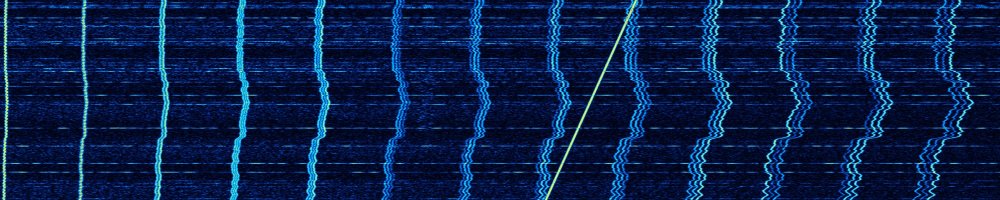
Dealing with QRM in the city
Finding and fighting man-made noise
Anyone operating from a town or city knows the problem: an S7 noise floor on 40m, a rattle on 20m every evening, or a buzz that wanders across the band. As I described on my QTH page, man‐made noise is a daily battle in a residential street. You can’t always solve it, but there is often more to gain than you’d think.
Table of Contents
Common sources
| Source | Typical sign |
|---|---|
| Switch‐mode power supplies and chargers | Spikes or a buzz every few kHz across the band |
| LED lighting and dimmers | Broadband noise, often only in the evening |
| Solar inverters and optimisers | Noise during daylight hours, gone at night |
| Powerline (PLC) network adapters | Strong broadband noise on HF, often with gaps on the amateur bands |
| VDSL and cable internet | Noise in fixed frequency ranges |
| Plasma and older TVs, monitors | Buzz with a regular pattern |
Start at home
The first suspect is in your own house. A simple test:
- Run the transceiver on a battery, or use a battery‐powered portable receiver.
- Switch off the main circuit breaker of your house.
- If the noise has gone, switch the groups back on one by one, and then unplug devices until you find the culprit.
Replacing a cheap power supply or LED lamp with a better one often solves the problem straight away.
Finding it outside
If the noise is still there with the power off, it comes from outside. A portable shortwave receiver or an SDR with a small loop antenna helps to locate it: walk around the neighbourhood and follow the noise where it gets stronger. Neighbours are usually willing to help once they understand the problem, especially if you can offer a practical solution.
Reducing it at your station
- Common‐mode chokes. Noise often travels along the outside of the coax. A choke of several turns of coax through a ferrite toroid (mix 31 for HF) at the feed point and at the entrance to the shack can lower the noise floor considerably.
- Antenna placement. Get the antenna as far away from the house and its wiring as possible. Even a few metres makes a difference.
- A receive antenna. A small magnetic loop or a separate receive antenna picks up less local noise than a transmit antenna close to the house.
- Noise blanker and noise reduction. The noise blanker of a transceiver like the IC‐7300 works well against spikes; noise reduction helps against broadband hiss, at some cost in audio quality.
- Digital modes. FT8 copes remarkably well with a high noise floor (see FT8 and FT4 operating tips).
Choosing ferrite
The type of ferrite (the “mix”) determines at which frequencies a choke works. Using the wrong mix is the most common reason a choke doesn’t help.
| Mix | Best for | Typical use |
|---|---|---|
| 31 | 160m to 10m | Common‐mode chokes on coax and mains leads for HF |
| 43 | 10m up to VHF | Chokes for the higher HF bands and 6m |
| 61 | VHF and UHF | Suppression on 2m and 70cm |
For a choke on HF, several turns of coax or cable through a large mix 31 toroid work much better than a single clip‐on ferrite. The page by PE1ABR, linked from useful links, has more on ferrite.
When nothing helps
Electrical devices have to meet the rules for electromagnetic compatibility (EMC): they may not cause harmful interference to radio reception. If a device you can’t do anything about keeps causing interference, you can report it to the government agency responsible for the radio spectrum in your country. Such an agency can measure the interference, trace the source and order the owner or supplier to fix a device that doesn’t comply.
Before you report it, it helps to prepare:
- A diary: when the interference occurs, on which bands and frequencies, and how strong it is.
- Evidence: a recording, a screenshot of the waterfall, or measurements with a portable receiver showing where it gets stronger.
- What you’ve tried: the steps on this page, so it’s clear the problem isn’t caused by your own station or house.
- A friendly word with the neighbours first. Most interference is solved without any official involvement, and a good relationship with the neighbours is worth more than a formal procedure.
Where to report depends on the country:
| Country | Agency |
|---|---|
| Netherlands | Rijksinspectie Digitale Infrastructuur (RDI) |
| Belgium | Belgian Institute for Postal Services and Telecommunications (BIPT) |
| Germany | Bundesnetzagentur (BNetzA) |
| France | Agence nationale des fréquences (ANFR) |
| Italy | Ministero delle Imprese e del Made in Italy (MIMIT), through its regional inspectorates (Ispettorati Territoriali) |
| Spain | Secretaría de Estado de Telecomunicaciones, through the provincial telecommunications inspection offices (Jefaturas Provinciales de Inspección de Telecomunicaciones) |
| Greece | Hellenic Telecommunications and Post Commission (EETT) |
| United Kingdom | Ofcom |
| United States | Federal Communications Commission (FCC) |
| Canada | Innovation, Science and Economic Development Canada (ISED) |
| Brazil | Agência Nacional de Telecomunicações (Anatel) |
| Japan | Ministry of Internal Affairs and Communications (MIC), through its regional Bureaus of Telecommunications |
| Australia | Australian Communications and Media Authority (ACMA) |
In other countries, look for the national telecommunications or spectrum regulator: the same body that issues amateur radio licences or registrations. Your national amateur radio society can usually tell you where to go, and many societies have an EMC or RFI team with practical experience, such as the RSGB EMC Committee in the UK and the ARRL RFI desk in the USA.